
- Subject Introduction
The Urology Center
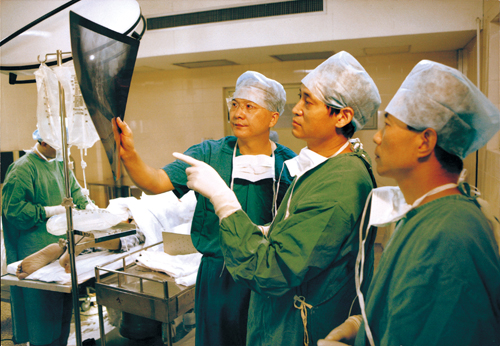
The Urology Center of Shanghai General Hospital was founded in early 1940s. Under the leadership of a group of professors such as Huang Zheng, Xie Tong, Xu Qinjun, Tang Xiaoda, Zhang Xianyou, Tan Jianming, and Xia Shujie. After years of effort, our center has now become one of the prestigious subject in China.
There are a total of 3 wards and 140 beds in our center in the north and south branch. In the past 3 years, the number of outpatients and emergency patients is about 120 thousand, and the number of inpatients is about 4,923
In order to carry out a wide range of scientific research on prostate disease, urinary tumor, minimally invasive endoscopic surgery, stress urinary incontinence, children with hypospadias formation, tissue engineering, and androgen receptor subtype of prostate disease, end-stage renal disease on dialysis, kidney transplantation immunity and gene type matching, our center has formed the leading research directions featured by transplantation immunology, gene matching, and androgen receptor related studies. Our center has won one “8th Five-Year” and “9th Five-Year” national key project, one "12th Five-Year" science and technology support project, 31 National Natural Science Foundation of China, more than 100 scientific research projects from Ministry of health, Ministry of science and technology, Shanghai Municipal Science and Technology Commission, and Health Bureau. Besides, the center succeeded in applying for a total of more than 70 million yuan research fund. More than 350 academic papers were published in academic journals at home and abroad, more than 70 of which were included in SCI journals. We are the chief editors of 9 monographs as well as editors of 21 monographs. We are the owners of 12 patents for invention or utility model. Furthermore, we have won the second prize of national scientific and technological progress (the study and clinical application of organ transplantation in Chinese Han population, 2001). In recent years, we attach great importance to the minimally invasive urology as well as application of new technology and complication prevention. Thus, we have made the relevant achievements such as the first prize of Shanghai science and technology progress (development and application of laser technology in minimally invasive urology, 2010), the first prize of Chinese medical science and technology progress (2013), the first prize of International Endoscopics Award(2009), the second prize of science and technology progress award of National Academy of Sciences, the second prize of Chinese Medical Science and Technology Progress Award, and more than 20 other achievements of Shanghai municipal or provincial awards which are above the third prize.
The Urology Center consists of Department of Prostate, Department of Urologic Oncology, Department of Urolithiasis, Department of Kidney Transplantation and Department of Andrology / pelvic and urinary incontinence surgery.
Department of Prostate
Department of Prostate specializes in the diagnosis and treatment of prostatic disease. Transurethral thulium laser resection of prostate-technique and laparoscopic radical prostatectomy are the specialties and characteristics of our department.
The transurethral thulium laser resection of prostate-tangerine technique was invented by Professor Xia Shujie, the director of our center, and it was first performed in our department for the treatment of benign prostatic hyperplasia in the world in 2004. The new technique has greatly improved the safety and efficiency of the operations of benign prostatic hyperplasia. Our department made academic reports and presentations at the international academic conferences for many times, and was highly praised by the international academic circles. The surgery-related papers published in European Urology, the most authoritative international journal of urology have been cited by guidelines of EAU and CUA. We have received invitations from Germany, France, Switzerland, Singapore and other countries to present academic achievements. This surgery is characterized by high efficiency, safety and evident therapeutic effect. High efficiency means that the removal rate is faster and the time of operation is greatly shortened. Safety means controlling bleeding at minimum level during surgery. The operation allows many high-risk patients who can not afford surgeries also get the opportunity of surgical treatment. After nearly 10 years of follow-up, it shows that the effect of the surgery is excellent, and the surgery has no impact on organ function.
In 2002, our department performed the first laparoscopic radical prostatectomy for prostate cancer in East China, and up to now, the patient is still in good health. We are the first department of Shanghai to introduce 3D laparoscopic technology. 3D laparoscopic radical prostatectomy has become a characteristic of our department. In the early stage of prostate cancer, intrafascial laparoscopic radical prostatectomy may be better performed to maintain the sexual function and urinary continence.
Department of Urologic Oncology
The main characteristic of Department of Urologic Oncology are minimally invasive surgery and comprehensive treatment of urinary tumors.
The main minimally invasive surgery techniques include laparoscopic and retroperitoneal laparoscopic techniques, thulium laser and holmium laser techniques, 3D laparoscopy techniques, laparoscopic ultrasonography and 3D imaging system. These techniques can cure over 90 percent of the genitourinary cancers, including adrenal tumors, renal neoplasm, renal pelvis carcinoma, ureteral tumors, bladder tumor, urogenital cancers (testicular tumors, penile cancer and tumors of scrotum) et al. Our department is able to perform more than 30 regular minimally invasive surgeries, including retroperitoneal laparoscopic partial nephrectomy, radical nephrectomy, radical nephroureterectomy of renal pelvis and ureteral carcinoma, ligation of renal lymphatic vessels, retroperitoneal lymphadenectomy, retroperitoneoscopic ureteral reimplautation, ureterovesical reimplantation, laparoscopic enucleation for huge adrenal tumors, radical cystectomy and construction of orthotopic neobladder, transurethral resection of bladder tumor, nephrectomy, pyeloplasty for ureteropelvic junction obstruction et al.
Our department take the lead in developing and reporting the cases of thulium laser en-bloc bladder cancer resection for treatment of non-muscle invasive bladder cancer. This technique have been proved to be effective. The department carried out clinical research of preoperative pirarubicin intravesical instillation for the diagnosis and treatment of carcinoma in situ of bladder cancer and that for the influence of cancer progression/recurrence postoperatively. We also performed superselective clamping of renal artery in retroperitoneal laparoscopic partial nephrectomy. A recent case that superselective clamping of renal artery in retroperitoneal laparoscopic sequential partial nephrectomy for treatment of multiple tumors on solitary kidneys is admired by many peers. The other new minimally invasive surgery techniques developed in recent years include three-port laparoscopic inguinal lymphadenectomy through abdominal wall for penile carcinoma, the refined retroperitoneal laparoscopic retroperitoneal lymph node dissection for testicular cancer and laparoscopic nephrectomy combined with inferior vena cava tumor thrombectomy.
Department of Urolithiasis
Our department is one of the first subjects in east China and shanghai to carry out minimally invasive surgical treatment for urinary calculi, especially minimally invasive percutaneous nephrolithotomy with holmium laser lithotripsy, ureteroscopic laser lithotripsy and laser lithotripsy with flexible ureteroscope for complicated upper urinary tract calculi. Our minimally invasive surgical techniques are in a leading position in China. We have unique advantages in minimally invasive treatment of upper urinary tract calculi, and we have achieved great clinical curative effect to cure varieties of complex cases, such as staghorn calculi, solitary kidney calculi, horseshoe kidney calculi, transplanted kidney calculi and some residual calculi, recurrent calculi and multiple renal calculi after open surgeries.
Our department carried out the first case of minimally invasive percutaneous nephrolithotomy in Shanghai in 2002, and now has successfully completed thousands of surgeries for urinary calculi. In recent years, encouraged by the completion of the first case of laser lithotripsy with flexible ureteroscope in Shanghai, we aimed at a more minimally invasive, non-invasive target and actively carried out laser lithotripsy with flexible ureteroscope for complicated upper urinary tract calculi.
Department of Kidney Transplantation
Renal Transplantation Department, the advanced department of our hospital, was founded by Professor Xie Tong, the extraordinary urology expert of our nation. The department performed the first renal transplantation from deceased donor in 1976, and is one of the first medical centers that carried out renal transplantation in China. Clinical medical center of organ transplantation of Shanghai was founded in August 2001 by the approval of Shanghai Municipal Government. Renal transplantation from deceased donor, autologous renal transplantation, living-donor renal transplantation, combined liver-kidney transplantation, combined pancreas-kidney transplantation, and combined kidney-adult islet cells transplantation etc.. Up to now, there are a total of over 2600 cases of renal transplantation, the number of annual transplantation being 50 to 100 cases, and with the youngest recipient aged 11 years old, and the oldest recipient aged 72 years old. The one-year survival rate for recipient/graft is 97.4% /93.2%, the five-year survival rate for recipient/graft is 86.6%/75.2%, and the ten-year survival rate for recipient/graft is 79.7%/66.1%. The longest survival has been more than 35 years.
Department of Andrology / pelvic and urinary incontinence surgery
Department of Andrology / pelvic and urinary incontinence surgery was founded on March 6, 2015. Our department carries out microsurgical techniques for male infertility, such as microsurgical vasoepididymostomy, microsurgical vasovasostomy, microsurgical varicocelectomy, microsurgical sperm retrieval of azoospermia, testicular sparing microsurgery for testicular tumor, microsurgical removal of testicular foreign body, microsurgical autotransplantation of testical.
On the basis of microsurgical andrology, the department focuses on developing minimal invasive techniques for laparoscopic testicular exploration of cryptorchidism, nerve-sparing and laparoscopic radical orchiectomy. We also applied laparoscopy combined with microscopic spermatic duct reconstruction techniques for iatrogenic azoospermia caused by hernia repair or hydrocelectomy, and ejaculatory function sparing techniques for ultrasound-guided transurethral resection of ejaculatory ducts.
Our department also specializes in male fertility evaluation, new technology of sperm cryopreservation, male sexual function evaluation, diagnosis, treatment and recovery, sexual and fertility function protection and recovery of prostatic diseases.
The department is specialized in pelvic and urinary control neurological and urodynamic examination, and focuses on urinary and sexual function combined recovery of pelvic diseases. The department masters unique and simplified surgical treatment for urinary incontinence. By the establishment of urinary incontinence patients’ sample database, we carries out the translational medical research for in-depth study on mechanisms of interplay between estrogen reduction and urinary function, and on stem cell therapy for urinary incontinence.