- News
Shanghai-Ulm Forum on Basic Research in Clinical Immunology Held Alongside Signing and Inauguration of Shanghai-Ulm Joint Clinical Immunology Research Center
Source: https://mp.weixin.qq.com/s/o3uxzcVsFBh1Nu3MSqQ68Q
On November 16, 2026, the Shanghai-Ulm Forum on Basic Research in Clinical Immunology was held at the Songjiang Campus of Shanghai General Hospital. Chinese and German experts and scholars from Shanghai General Hospital, Ulm University Medical Faculty, and Ulm University Hospital engaged in in-depth discussions on cutting-edge topics in clinical immunology. They also witnessed the signing and inauguration of the Shanghai-Ulm Joint Clinical Immunology Research Center, establishing a long-term platform for high-level international collaboration in medical research.
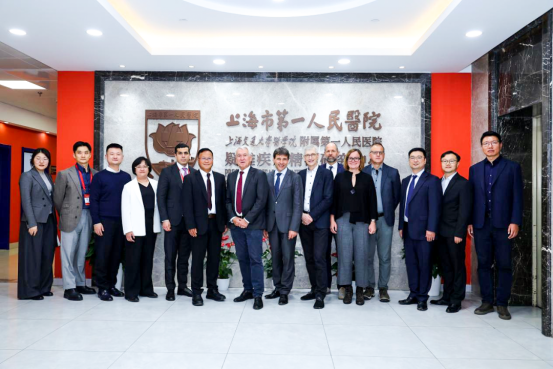
The German delegation was led by Professor Thomas Wirth, Dean of the Medical Faculty at Ulm University. Members included Professor Markus Huber-Lang, Vice Dean of the Medical Faculty and Director of the Institute of Clinical and Experimental Trauma Immunology; Professor Hartmut Geiger, Director of the Institute of Molecular Medicine; Professor Miriam Erlacher, Director of the Department of Pediatrics and Adolescent Medicine; Professor Thomas Seufferlein, Director of Department of Internal Medicine I; Professor Nu Rahbari, Director of the Department of General and Visceral Surgery; and Dr. Christoph Meier, Director of the Center for Research Strategy and Support.
Representatives from Shanghai General Hospital included Professor Wang Honglin, Executive Vice Dean of the Institute of Clinical Research and Deputy Director of the National Key Laboratory of Innovative Immunotherapy; Fang Liu, Director of the Office of International Cooperation and Exchange; Professor Long Jiang, Deputy Director of the General Surgery Clinical Medical Center and Director of Pancreatic Surgery; as well as group leaders and researchers from the Precision Research Center for Difficult and Complex Diseases at the Institute of Clinical Research. The forum was chaired by Professor Jiang Dongsheng of Shanghai General Hospital.
Professor Wang Honglin delivered the opening remarks, warmly welcoming the delegation from Ulm University. He noted that Shanghai General Hospital and Ulm University each have distinctive strengths in basic research, clinical medicine, and translational medicine, with highly complementary expertise that creates significant opportunities for collaboration. The Shanghai-Ulm Joint Clinical Immunology Research Center will focus on collaborative research, academic exchange, and the development of young scientists, serving as a strong foundation for sustained partnership between the two institutions. Professor Wang expressed particular appreciation to Professor Thomas Wirth and colleagues at Ulm University for their efforts in advancing bilateral collaboration. He emphasized that the signing of the cooperation agreement and the inauguration of the center marked an important milestone. He looked forward to turning discussions at the forum into concrete research initiatives, shared scientific discoveries, and meaningful exchanges and training opportunities for young researchers.
Professor Thomas Wirth subsequently delivered remarks, expressing his sincere appreciation for the warm welcome and thoughtful arrangements provided by Shanghai General Hospital. He noted that the inauguration of the Shanghai-Ulm Joint Clinical Immunology Research Center represented a major milestone in the partnership. Through the center, he hoped the two sides would continue to advance joint research projects, address frontier questions in clinical immunology, accelerate the translation of basic research into clinical applications, and generate high-quality scientific that would ultimately benefit patients in both countries.
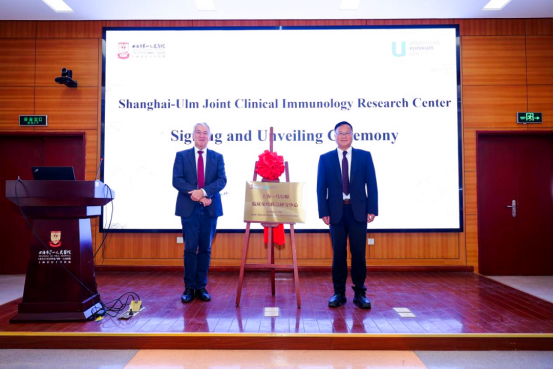
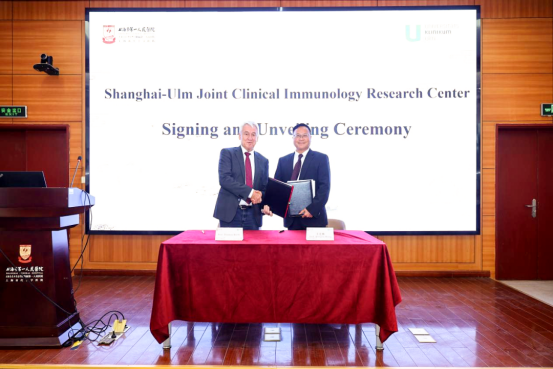
The signing and inauguration ceremony of the Shanghai-Ulm Joint Clinical Immunology Research Center was subsequently held. Professor Wang Honglin and Professor Thomas Wirth signed the cooperation agreement on behalf of the two institutions and jointly unveiled the center. Leveraging their complementary strengths in clinical resources, basic research, and translational research platforms, the center will focus on major scientific questions in clinical immunology and advance collaborative research. Its establishment marks a new phase in medical cooperation between Shanghai General Hospital and Ulm University, one characterized by more structured, sustained, and institutionalized collaboration.
Following the ceremony, six academic presentations were delivered, with sessions chaired by Professors Jiang Dongsheng, Guo Bin, Dong Shuxian, Zhou Luming, Lu Pengfei, and Wang Yiping of Shanghai General Hospital.
Professor Markus Huber-Lang presented Molecular Danger Responses Following Tissue Injury: Trauma Research at Ulm University. He provided an overview of recent advances in understanding systemic inflammation and organ crosstalk in polytrauma, shock, and sepsis, highlighting research progress in complement-coagulation interactions and targeted immunomodulation.
Professor Miriam Erlacher delivered a presentation entitled Immunity and Hematologic Diseases: From Treatment to Prevention. She discussed the regulation of cell death, hematopoiesis, bone marrow failure, and childhood leukemia, and introduced a European registry study on myelodysplastic syndromes in children led by her research team.
Professor Hartmut Geiger presented Molecular Mechanisms of Stem Cell Aging and Regeneration. He shared findings on hematopoietic stem cell aging and rejuvenation, stem cell niches, and regenerative strategies, and introduced the organizational experience of the Collaborative Research Center “Aging at Interfaces,” funded by the German Research Foundation (DFG).
Chinese researchers also presented their latest findings. Professor Chen Sisi delivered Mechanisms and Targeted Interventions in Myeloid Malignancies Harboring Splicing Factor Mutations. Professor Lou Fangzhou presented Neuro-Stromal Interactions in Keloids: Mechanisms and Translational Therapeutic Approaches. Dr. Wang Zhikai presented Regulation of Aging by Skin-Innervating Glutamatergic Neurons. These presentations showcased recent advances from the Institute of Clinical Research in hematologic malignancies, chronic inflammation and fibrosis, and neuroimmune regulation.
Following the presentations, participating experts engaged in lively academic discussions, exchanging perspectives on the research findings and potential areas for future collaboration. The dialogue sparked new scientific ideas and explored promising approaches to jointly address complex medical challenges.
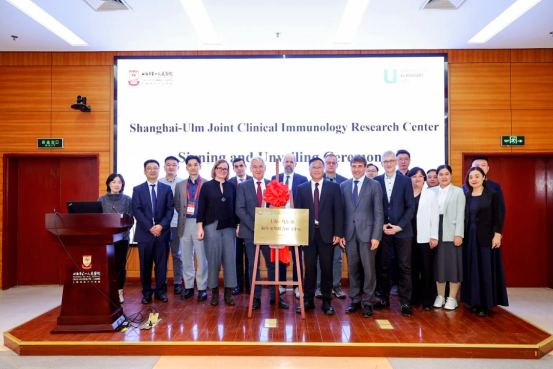
At the conclusion of the forum, Professor Wang Honglin delivered closing remarks and expressed his gratitude to the German delegation in German, saying, “Vielen Dank.” He emphasized that the significance of the forum extended beyond the establishment of a new joint research center—it marked the beginning of a long-term and productive scientific partnership. He expressed his hope that both sides would use the centre as a platform to advance joint research projects, promote the exchange of researchers, strengthen the joint training of young scientists, and transform the ideas generated at the forum into clinical and basic research outcomes of significant impact. He also looked forward to welcoming his German colleagues back to Shanghai to continue academic exchanges and cooperation.
Following the forum, the German delegation visited the Institute of Clinical Research to learn more about its research platforms, laboratory facilities, and strategic research priorities, gaining further insight into the hospital’s research infrastructure and scientific programs.
The forum and signing and inauguration ceremony established a bridge for regular academic communication and collaboration between Shanghai General Hospital and Ulm University in Germany. Building on major clinical challenges, the Shanghai-Ulm Joint Research Center for Clinical Immunology will bring together the expertise and strengths of both sides, promote bidirectional translation between basic and clinical research, and support the development of research talent. Together, the two institutions are opening a new chapter in international medical collaboration between China and Germany.