
- News
Shanghai General Hospital Wang Jun’s Team Identifies Airway Epithelial TDP-43 as a Potential Therapeutic Target for Asthma and Influenza-Associated Acute Exacerbations
Source: https://mp.weixin.qq.com/s/lFtcMZUTJgFTah9ggafS6A
Asthma is a chronic inflammatory disease of the airways that affects approximately 334 million people worldwide and causes an estimated 400,000 deaths annually [1]. Current first-line treatments primarily include corticosteroids and bronchodilators. Although these therapies can alleviate symptoms and control inflammation, they do not fully address the underlying disease mechanisms, and long-term corticosteroid use may be associated with significant adverse effects.
Asthma is broadly classified into type 2 (T2) asthma, characterized predominantly by eosinophilic inflammation, and non-T2 asthma, which is often associated with neutrophilic inflammation. Non-T2 asthma accounts for an estimated 30–50% of cases and is frequently resistant to corticosteroid treatment. Currently approved targeted therapies are not generally applicable to this patient population, leaving a substantial unmet need for effective treatment options [2].
Acute exacerbations are a major cause of asthma-related mortality, with the vast majority of exacerbation events triggered by respiratory viral infections [3]. However, treatment for virus-associated exacerbations generally follows conventional asthma management strategies rather than directly targeting the underlying viral infection, and treatment efficacy remains limited in some patients. A single therapeutic target capable of addressing both asthma pathology and associated respiratory viral infection has yet to be established.
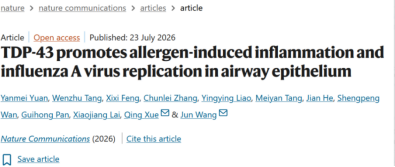
On July 23, 2026, a team led by Professor Wang Jun at Precision Research Center for Difficult Diseases, Shanghai General Hospital, in collaboration with Professor Xue Qing’s team at Fujian Medical University Ningde Hospital, published a study online in Nature Communications entitled “TDP-43 promotes allergen-induced inflammation and influenza A virus replication in airway epithelium” [4]. Using allergen-induced disruption of RNA quality control in airway epithelial cells as a starting point, the researchers identified an important role for TDP-43, a key regulator of RNA metabolism. They found that aberrantly elevated TDP-43 expression impairs UPF1-mediated nonsense-mediated mRNA decay (NMD), leading to the abnormal accumulation of disease-promoting, NMD-sensitive transcripts and contributing to the development and progression of both T2 and non-T2 asthma. The study further demonstrated that TDP-43 can directly promote influenza A virus replication in airway epithelial cells, potentially contributing to acute asthma exacerbations associated with influenza infection. These findings identify airway epithelial TDP-43 as a potential therapeutic target for asthma across inflammatory subtypes and for influenza-associated acute exacerbations.
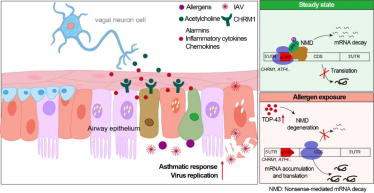
Chronic cellular stress can compromise RNA quality-control mechanisms, including by reducing NMD activity [5]. However, whether NMD function is impaired in the airway epithelium of patients with asthma has remained unclear. The researchers first demonstrated that allergen exposure impairs NMD activity in asthmatic airway epithelium, with this phenomenon showing a high degree of conservation between humans and mice. TDP-43 is a highly conserved RNA- and DNA-binding protein that normally localizes to the nucleus. By binding to RNA substrates enriched in UG sequences, it regulates multiple aspects of RNA metabolism, including splicing and RNA stability [6]. In motor neurons, nuclear clearance of TDP-43 and its accumulation in the cytoplasm are characteristic pathological features of neurodegenerative diseases, including amyotrophic lateral sclerosis (ALS) [7]. Cellular stress can induce aberrant TDP-43 upregulation, abnormal intranuclear condensation and cytoplasmic aggregation, thereby disrupting RNA quality-control processes, including NMD [8, 9]. Based on these observations, the researchers hypothesized that abnormal TDP-43 expression and subcellular distribution might contribute to NMD dysfunction in asthmatic airway epithelium.
Through systematic mechanistic investigations, the team found that allergen exposure increased TDP-43 expression and altered its intranuclear distribution in airway epithelial cells. TDP-43 subsequently disrupted NMD activity by altering UPF1 splicing and promoting its degradation through an instability-associated mechanism. This impairment led to the accumulation of NMD-sensitive, disease-associated transcripts, including CHRM1 and ATF4, contributing to the development and progression of both non-T2 and T2 asthma. Among these downstream targets, CHRM1 encodes the M1 muscarinic acetylcholine receptor, which mediates signaling by acetylcholine released from the vagus nerve and can promote asthma-related responses. Beyond its role in allergen-induced airway inflammation, the study found that TDP-43 directly promotes influenza A virus replication in airway epithelial cells.
To explore its therapeutic potential, the researchers developed a treatment approach using lipid nanoparticles to deliver antisense oligonucleotides targeting TDP-43 through intranasal administration. In mouse models, this approach safely and effectively alleviated pathological features of allergen-induced T2 and non-T2 asthma. These preclinical findings support further investigation of airway epithelial TDP-43 inhibition as a potential strategy for treating different asthma endotypes and influenza-associated acute exacerbations.
Dr. Yuan Yanmei and Zhang Chunlei from Precision Research Center for Difficult Diseases at Shanghai General Hospital; Tang Wenzhu and He Jian from Guangzhou Women and Children’s Medical Center; Feng Xixi, a master’s student at Guangzhou Medical University; Liao Yingying, a doctoral student at Shanghai Normal University; and Associate Chief Physician Tang Meiyan from the Department of Pulmonary and Critical Care Medicine at Ningde Hospital are the co-first authors of the paper. Research Professor Wang Jun from Shanghai General Hospital and Professor Xue Qing from Ningde Hospital are the co-corresponding authors
The research was supported by the National Natural Science Foundation of China, the National High-Level Young Talent Program, the Guangdong Basic and Applied Basic Research Foundation and an open research grant from the National Center for Translational Medicine (Shanghai).
The team also acknowledges the valuable support and expert advice provided by Professor Jin Shouheng of Sun Yat-sen University; Professor Zhang Min, Dr. Han Lei and Dr. Su Hang from the Department of Pulmonary and Critical Care Medicine at Shanghai General Hospital; and Director Fang Guiju from the Department of Pulmonary and Critical Care Medicine at Ningde Hospital.
Link to the published paper: https://doi.org/10.1038/s41467-026-75901-0
Reference:
[1] Ann Glob Health. 2019 Jan 22;85(1):2. doi: 10.5334/aogh.2412.
[2] Am J Respir Crit Care Med. 2022 Sep 1;206(5):545-553. doi: 10.1164/rccm.202201-0129OC.
[3] J Allergy Clin Immunol. 2020 May;145(5):1332-1344. doi: 10.1016/j.jaci.2019.12.904.
[4] Nat Commun. 2026 July 23; https://doi.org/10.1038/s41467-026-75901-0.
[5] RNA. 2017 Mar;23(3):378-394. doi: 10.1261/rna.058040.116.
[6] Nat Rev Neurosci. 2021 Apr;22(4):197-208. doi: 10.1038/s41583-021-00431-1.
[7] Science. 2006 Oct 6;314(5796):130-3. doi: 10.1126/science.1134108.
[8] Cell Rep. 2024 Jul 23;43(7):114421. doi: 10.1016/j.celrep.2024.114421.
[9] EMBO J. 2023 Sep 4;42(17):e111719. doi: 10.15252/embj.2022111719