
- News
Jia Deshui's Team Uncovers a Novel Mechanism of Immune Evasion in Small Cell Lung Cancer and Identifies a Potential Combination Therapy Strategy
Source: https://mp.weixin.qq.com/s/OYqffmGf8OtPpOKdQTIRhg
Small cell lung cancer (SCLC) accounts for approximately 15% of all lung cancer cases. It is an aggressive neuroendocrine malignancy characterized by rapid progression. In recent years, programmed death-ligand 1 (PD-L1) inhibitors in combination with chemotherapy have become a first-line treatment option for extensive-stage SCLC. However, the overall clinical benefit of immunotherapy remains limited, and the mechanisms underlying immune evasion in SCLC are not yet fully understood. Elucidating how the immunosuppressive tumor microenvironment develops and identifying strategies to enhance sensitivity to immunotherapy are therefore important unmet research priorities.
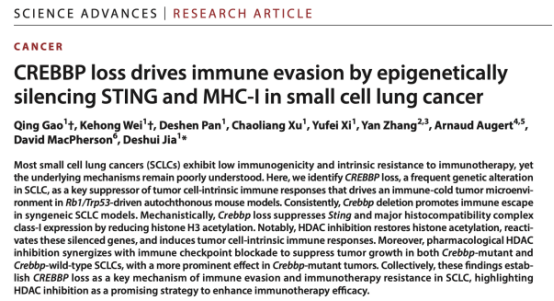
On October 21, 2026, a research team led by Research Professor Jia Deshui at Shanghai General Hospital published a study in Science Advances entitled “CREBBP loss drives immune evasion by epigenetically silencing STING and MHC-I in small cell lung cancer.”
The study reveals a previously unrecognized mechanism by which loss of the histone acetyltransferase CREBBP promotes immune evasion in SCLC through epigenetic repression of the cyclic GMP–AMP synthase (cGAS)–stimulator of interferon genes (STING) innate immune signaling pathway and major histocompatibility complex class I (MHC-I) expression. The researchers further found that the histone deacetylase (HDAC) inhibitor pracinostat, in combination with a PD-L1 inhibitor, may improve the response to immunotherapy in CREBBP-mutant SCLC. These findings provide a new mechanistic rationale for developing strategies to enhance immunotherapy sensitivity in SCLC.
CREBBP Loss Drives Epigenetic Reprogramming and Suppresses Innate Immunity and Antigen Presentation
CREBBP and its paralog EP300 are important epigenetic regulators that function as histone acetyltransferases. Loss-of-function mutations in these genes are frequently observed in SCLC. In previous work, the research team demonstrated that CREBBP loss promotes SCLC development and progression by inducing epithelial–mesenchymal transition (EMT) (Cancer Discovery, 2018; Jia et al.). That study highlighted the important role of epigenetic regulation in SCLC progression.
Building on these findings, the current study establishes a link between CREBBP loss and an immunosuppressive phenotype in SCLC. By integrating analyses of clinical specimens, transcriptomic data and functional experiments, the researchers found that CREBBP loss markedly reduced the expression of genes involved in tumor-cell-intrinsic innate immune signaling and antigen presentation. It was also associated with reduced immune-cell infiltration into tumors. Further analysis of clinical data suggested that CREBBP mutations or low CREBBP expression were associated with poorer responses to immunotherapy in patients with SCLC.
Mechanistic investigations showed that CREBBP loss epigenetically represses key immune-related genes, including STING and genes encoding MHC-I molecules, thereby attenuating cGAS–STING pathway activity and impairing tumor antigen presentation.
In addition, expression of chemokines such as CXCL14 was suppressed, potentially limiting the recruitment of CD8-positive T cells into tumor tissue. Together, these changes contribute to the establishment of an immunosuppressive tumor microenvironment, enabling tumor cells to evade immune surveillance.
HDAC Inhibition Restores Tumor Immune Functions and Suggests a New Approach to Combination Immunotherapy
To explore potential therapeutic strategies, the researchers investigated whether targeting epigenetic regulation could reverse the immune-suppressive effects of CREBBP loss. They found that the HDAC inhibitor pracinostat alleviated CREBBP loss-associated epigenetic silencing of immune-related genes and restored the expression of molecules involved in antitumor immunity, including STING. This was accompanied by reactivation of innate immune signaling and increased tumor immunogenicity.
In animal models, the combination of pracinostat and a PD-L1 inhibitor demonstrated greater antitumor activity than either treatment alone. These findings suggest that combining epigenetic modulation with immune checkpoint blockade may represent a potential strategy for improving immunotherapy responses in CREBBP-deficient SCLC.
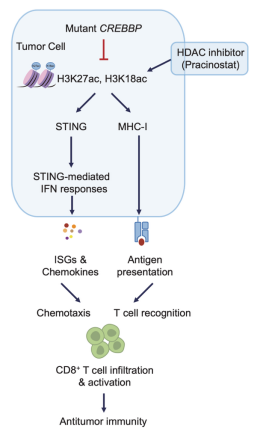
The study identifies a mechanism through which CREBBP loss promotes immune evasion by coordinately suppressing innate immune signaling and antigen presentation through epigenetic regulation. It also offers new insight into the molecular basis of the immunologically “cold” phenotype observed in SCLC.
Furthermore, the findings provide preclinical evidence supporting the investigation of HDAC inhibition as a means of restoring tumor immune functions and potentially enhancing the activity of immune checkpoint inhibitors. This approach may inform future efforts to stratify patients with SCLC according to molecular characteristics and develop more effective combination treatment strategies.
Building on the rationale for combining HDAC inhibition with immune checkpoint blockade, related clinical translational research is also progressing. A registered, single-arm clinical study is currently exploring entinostat in combination with adebrelimab as second-line treatment for extensive-stage SCLC (Clinical Trial Registration No. ChiCTR2600130652). The study aims to evaluate the efficacy and safety of this combination regimen. The clinical study may provide evidence to inform further investigation of combined epigenetic modulation and immunotherapy in SCLC.
Gao Qing, a doctoral student in the 2023 cohort, and Wei Kehong, a doctoral student in the 2024 cohort at Shanghai Jiao Tong University School of Medicine, are co-first authors of the paper. Research Professor Jia Deshui is the corresponding author. The study was supported by the National Natural Science Foundation of China, the Shanghai Pujiang Program and other research funding initiatives.
Link to the published paper: https://www.science.org/doi/10.1126/sciadv.aef1693?url_ver=Z39.88-2003&rfr_id=ori:rid:crossref.org&rfr_dat=cr_pub%20%200pubmed