- News
Four Research Achievements Showcase Shanghai General Hospital’s Strength in Critical Care Medicine at the 39th Annual Congress of the European Society of Intensive Care Medicine
Source: https://www.shgh.cn/Content/News/17295
The 39th annual congress of European Society of Intensive Care Medicine (ESICM LIVES 2026) was held in Lisbon, Portugal, from October 10 to 14. As one of the world’s leading academic gatherings in critical care medicine, the congress brought together leading experts from around the globe to explore advances in sepsis, acute respiratory failure, organ protection, precision medicine and the application of artificial intelligence in critical care.
Professor Wang Ruilan, Director of the Department of Emergency and Critical Care Medicine at Shanghai General Hospital, led a team to the congress, where they presented four research achievements spanning clinical sepsis research, the mechanisms underlying severe viral pneumonia, risk prediction in respiratory support, and AI-assisted precision treatment. Through an invited scientific presentation, poster sessions and participation in an international forum, the team highlighted its research capabilities and commitment to clinical innovation in critical care medicine.
Multicenter Clinical Trial Provides Evidence to Guide Sepsis Treatment
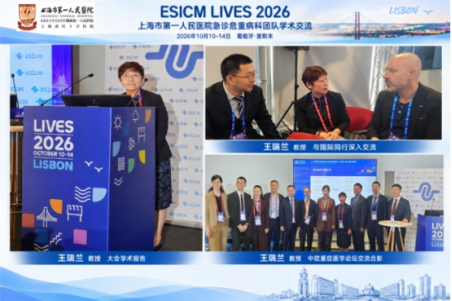
During the congress, Professor Wang delivered a scientific presentation on the RESCUE multicenter randomized controlled trial led by her team. The study investigated the efficacy and safety of recombinant human thrombopoietin (rhTPO) in patients with sepsis complicated by severe thrombocytopenia. Addressing the limited clinical evidence available to guide treatment in this patient population, the team conducted a prospective, multicenter, randomized, open-label, controlled trial to systematically evaluate the clinical value of the intervention. The findings showed that improvement in platelet counts did not directly translate into a survival benefit. The results provide objective evidence to inform the appropriate clinical use of rhTPO and lay the groundwork for future research to identify patient subgroups most likely to benefit and optimize treatment strategies.
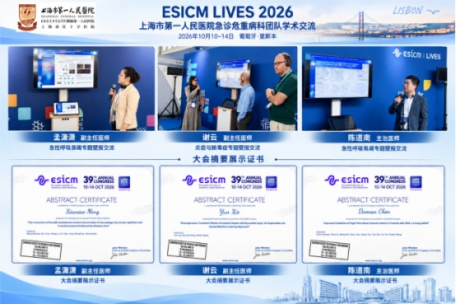
In addition to the main scientific session, three early-career physicians from the team presented their findings in poster sessions across three major areas: disease mechanisms, bedside clinical care and artificial intelligence applications.
Sema3E May Help Explain Inflammatory Responses in Severe Influenza Pneumonia
Associate Chief Physician Meng Xiaoxiao presented research in the acute respiratory failure session examining the role of semaphorin 3E (Sema3E), derived from alveolar epithelial cells, in macrophage inflammatory activation during influenza virus infection. Severe influenza-associated viral pneumonia can trigger excessive pulmonary inflammation and progress to respiratory failure. Using human lung tissue samples, an H1N1 infection animal model and cellular experiments, the team found that Sema3E expression in alveolar epithelial cells increased following viral infection, accompanied by enhanced macrophage-associated inflammatory responses. By examining the interactions between epithelial cells and immune cells, the study offers new insights into the mechanisms that amplify inflammation in severe viral pneumonia.
Dynamic ROX Index Changes May Improve Prediction of HFNC Treatment Failure
Attending Physician Chen Daonan presented research in the acute respiratory failure session on using dynamic changes in the ROX index to predict the risk of high-flow nasal cannula (HFNC) therapy failure. HFNC is widely used to provide respiratory support for patients with acute respiratory failure. Early identification of patients at risk of treatment failure is essential to avoid delays in escalating respiratory support when clinically indicated. The team conducted a retrospective cohort study using the MIMIC-IV database and performed external validation in a clinical cohort at Shanghai General Hospital. The researchers analyzed changes in the ROX index during the hour after the index fell to 5 or below. The results showed that lower changes in the ROX index (ΔROX) were associated with a higher risk of HFNC treatment failure. Combining this dynamic measure with the baseline ROX index further improved short-term risk prediction. Because the approach relies solely on routinely collected bedside monitoring data, it offers a clinically practical strategy for more precise monitoring and management of respiratory support.
Explainable and Causal Machine Learning Explores Heterogeneous Responses to Early Esmolol Treatment
Associate Chief Physician Xie Yun presented research in the inflammation and sepsis session investigating the heterogeneous effects of early esmolol treatment in sepsis-associated myocardial injury using explainable and causal machine learning. Sepsis-associated myocardial injury is closely linked to adverse patient outcomes, while treatment responses can vary considerably among individuals. The study found that the LightGBM model demonstrated good predictive performance. Key factors associated with prognosis included the Acute Physiology and Chronic Health Evaluation II (APACHE II) score, Sequential Organ Failure Assessment (SOFA) score, D-dimer level, age and procalcitonin level. Causal machine learning analyses further suggested an association between early esmolol administration and a lower risk of 28-day mortality, with potentially greater benefits among more severely ill patients. These findings require further validation in prospective clinical studies before firm conclusions can be drawn about treatment effects.
International Dialogue Strengthens Collaboration in Sepsis Care
Beyond presenting their research, the team participated in a dedicated forum entitled The Sino-European Critical Care Debate: Implementing Sepsis Guidelines Across Different Healthcare Systems—Challenges and Opportunities. Experts from China and Europe exchanged views on implementing sepsis guidelines, standardizing clinical practice and addressing challenges encountered in routine patient care. Drawing on its experience in clinical practice in China, the Shanghai General Hospital team shared perspectives on translating evidence-based recommendations into clinical care. The discussion deepened understanding of differences in guideline implementation across healthcare systems and created further opportunities for academic collaboration and the exchange of clinical experience between China and Europe.
From multicenter clinical trials and fundamental investigations into disease mechanisms to bedside risk prediction and AI-assisted treatment decisions, the four studies presented at ESICM LIVES 2026 addressed key challenges in critical care medicine. Together, they reflect the department’s commitment to addressing unmet clinical needs and advancing both basic and clinical research.
In recent years, the Department of Emergency and Critical Care Medicine at Shanghai General Hospital has received multiple academic development and discipline-support designations, including recognition as a key hospital discipline, an important discipline requiring strengthening within Shanghai’s health system, a key discipline in Shanghai’s public health development initiatives, and a key supported discipline within the municipal health system. In 2023, the department was designated a National Clinical Key Specialty, marking a further milestone in its development. Its overall clinical and research capabilities, as well as its regional influence, have continued to grow.
Building on an integrated emergency department–intensive care unit (ICU) care model, the department continues to focus on severe pneumonia, sepsis, cardiopulmonary-cerebral resuscitation and acute poisoning. It is committed to strengthening clinical care, research innovation and the development of medical talent.
Looking ahead, the team will continue to work at the forefront of critical care, deepen domestic and international academic collaboration, and translate high-quality research findings into clinical practice. Through these efforts, the department aims to improve outcomes for critically ill patients and contribute to the continued advancement of critical care medicine.