
- News
Strengthening China–Africa Urology Collaboration: Shanghai General Hospital Hosts Fourth “U-Road to the Future” Online Surgery Express Academic Program
Source: https://mp.weixin.qq.com/s/urg-CfQbGpM8ZP6lqWI6Lw
Utilizing digital technology to share surgical expertise and advance urological care across China and Africa, the Chinese Urological Association, the China–Africa Urology Alliance, the Pan African Urological Surgeons’ Association, and the Egyptian Urological Association hosted the fourth edition of the China–Africa Online Surgery Express Academic Program, themed “U-Road to the Future”, on July 28 at Shanghai General Hospital. The event was also part of the academic program marking the 80th anniversary of the establishment of the Department of Urology at Shanghai General Hospital. The event brought together nearly 20 Chinese and African experts in the field of urology, and through live surgical demonstrations and case-based discussions, it provided frontline African physicians with standardized minimally invasive diagnostic and treatment protocols, thereby continuing to strengthen professional collaboration between the two regions.
Since the establishment of the China–Africa Urology Alliance, Shanghai General Hospital has remained committed to the principles of shared expertise, joint infrastructure development, and collaborative mechanisms. As one of the alliance’s key academic exchange initiatives, the Online Surgery Express Academic Program has gained recognition among African urologists for its practical, clinically relevant instruction and its emphasis on standardized minimally invasive techniques. It has become an established platform for ongoing professional exchange between Chinese and African urology specialists. The Egyptian Urological Association’s active participation as a co-organizer of this edition further broadened the scope of collaboration and provided fresh momentum for cooperation in healthcare between China and Africa.
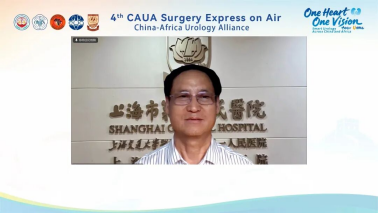
Professor Xia Shujie, Conference Chair, Director of the Shanghai Jiao Tong University Institute of Urology, and academic lead of the Urology Clinical Medicine Center at Shanghai General Hospital, highlighted the progress made by the alliance in his opening remarks. Nearly one year after its establishment, the alliance has continued to advance its principles and collaborative mechanisms. As one of the alliance’s founding core members, Shanghai General Hospital has actively organized in-person international exchanges, specialized training programs, and online live surgical demonstrations. Professor Xia noted that the Online Surgery Express Academic Program serves as a central platform for implementing the alliance’s objectives. By overcoming geographical barriers, it brings standardized minimally invasive techniques directly to clinicians on the front lines of care in Africa, helping more patients in both regions benefit from accessible, high-quality medical services.

Professor Han Bangmin, Co-Chair of the event, Vice President of Shanghai General Hospital, and Director of its Urology Clinical Medicine Center, emphasized the department’s longstanding commitment to minimally invasive urological surgery. The hospital has developed a comprehensive minimally invasive treatment system incorporating thulium and holmium laser technologies as well as surgical robotics, enabling continued advances in procedures for urinary stones, prostate diseases, and urological cancers. Professor Han explained that the program would share the hospital’s established approaches to laser-based minimally invasive procedures and robot-assisted surgery, providing African clinicians with standardized, practical techniques that can be adapted to local clinical settings.
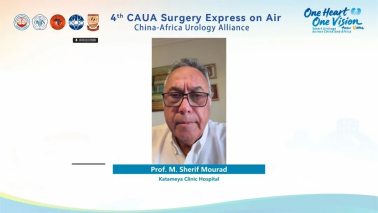
Professor M. Sherif Mourad, Secretary-General of the Egyptian Urological Association and Co-Chair of the event, noted that the demand for urological care across Africa remains substantial, while access to advanced surgical training is often limited. He highlighted the program’s combination of live surgical demonstrations and interactive question-and-answer sessions as an effective, practice-oriented approach to strengthening the procedural skills of local clinicians. He expressed his hope that long-term cooperation between Chinese and African urology specialists would continue to deepen, contributing to improvements in urological care across Africa.
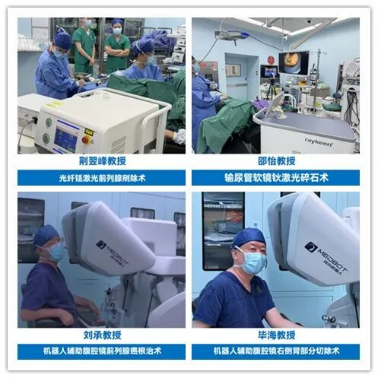
The program focused on four major conditions commonly encountered in clinical practice across Africa: benign prostatic hyperplasia (BPH), urinary stone disease, prostate cancer, and kidney tumors. Four specialists from Shanghai General Hospital—Jing Yifeng, Shao Yi, Liu Cheng, and Bi Hai—performed live demonstrations of four minimally invasive procedures, showcasing integrated solutions that combine domestically developed medical equipment with Chinese surgical expertise.
During the thulium laser enucleation of the prostate demonstration, the team showed how the technique could be tailored to patients with complex prostatic anatomy, while discussing individualized treatment strategies for prostates of different sizes and standards for postoperative management.
The holmium laser lithotripsy demonstration featured a domestically developed wireless dual-foot-pedal system. The team highlighted its role in efficient stone fragmentation and intraoperative hemostasis, with the aim of minimizing the risk of renal tissue injury.
Two robot-assisted surgeries, leveraging high-definition visualization and the precise manipulation of robotic arms, successfully performed a radical prostatectomy and a partial nephrectomy, respectively, eradicating the lesions while maximizing the preservation of organ function.
Throughout the demonstrations, urologists from across Africa actively raised questions grounded in their local clinical experience. Discussions addressed equipment selection, the management of large prostates, complication prevention, and the practical requirements for implementing advanced procedures in resource-constrained settings. Chinese experts responded with practical recommendations drawn from their clinical experience, focusing on approaches that could be adapted and implemented in different healthcare environments. Senior experts from both China and Africa took turns moderating the discussions, encouraging the exchange of clinical insights and technical perspectives. The interactive format fostered mutual learning and a two-way exchange of expertise.
In the closing remarks, Professor Xia Shujie emphasized the clinical value of laser technologies and robotic surgery in managing complex urological conditions. He noted that these techniques offer potential pathways for expanding access to minimally invasive treatment in areas with limited medical resources. By using a digital platform to overcome geographical barriers, the program has helped strengthen communication and collaboration between Chinese and African urology specialists.
Looking ahead, the China–Africa Urology Alliance will continue to develop the Online Surgery Express Academic Program as a flagship initiative, diversify its collaborative activities, and deepen technical training and support. Through sustained partnerships and long-term capacity building, the alliance aims to strengthen urological care across Africa and contribute to closer medical cooperation and shared health development between China and Africa.