
- News
Shanghai General Hospital Performs Golog Tibetan Autonomous Prefecture's First ERCP Procedure, Filling a Gap in Regional Medical Services
Source: https://mp.weixin.qq.com/s/UxUprofORB6NaBPijQ2lTw
A medical assistance specialist from Shanghai General Hospital has led a team at Golog Tibetan Autonomous Prefecture (Golog Prefecture) People’s Hospital in successfully performing the first endoscopic retrograde cholangiopancreatography (ERCP) procedure in Golog Prefecture, Qinghai Province. The procedure successfully treated a patient with complex biliary stones, marking a major breakthrough in minimally invasive treatment for complex biliary diseases in the region.
Dr. Hu Jiangfeng, a gastroenterologist and member of the sixth cohort of medical professionals participating in Shanghai’s group-based assistance program for Qinghai, led the procedure in collaboration with the surgical team at Golog Prefecture People’s Hospital. The successful introduction of ERCP fills a longstanding gap in the region’s technical capabilities and expands access to advanced minimally invasive treatment for complex biliary conditions.
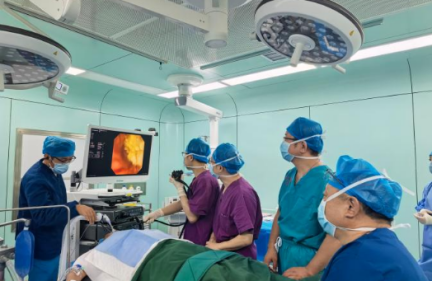
The patient was a 52-year-old Tibetan woman who was admitted with right upper abdominal pain and mild scleral icterus. Following a comprehensive diagnostic workup, she was diagnosed with a gallbladder filled with stones, common bile duct stones, and gallbladder enlargement. Her condition was clinically complex. Conventional management would have required staged procedures under multiple episodes of anesthesia, subjecting her to repeated interventions and potentially prolonging her hospital stay, which could further complicate postoperative recovery at high altitude
To alleviate the patient’s suffering and reduce the burden of treatment, Dr. Hu drew on the Shanghai–Qinghai medical aid partnership and worked closely with the surgical team at Golog Prefecture People’s Hospital. After several rounds of multidisciplinary discussion and careful evaluation of the patient’s condition, high-altitude physiological considerations, and imaging findings, the team developed a minimally invasive treatment plan centered on ERCP.
As this was the first ERCP procedure performed in Golog Prefecture, Dr. Hu also trained local medical and nursing staff from the ground up, equipping them with the skills needed to support the procedure and helping establish a coordinated team capable of working together in the operating room.
During the operation, the team encountered a rare biliary anatomical anomaly that made local tissue structures difficult to identify and significantly increased procedural complexity and risk. The team responded calmly and methodically, completing the cholecystectomy while taking care to avoid complications such as bile duct injury.
Following the completion of gallbladder removal, Dr. Hu proceeded with the endoscopic ERCP procedure and successfully extracted the common bile duct stones. Intraoperative cholangiography confirmed that no residual stones remained. The combined procedure was completed efficiently, precisely, and safely.
The patient recovered well after surgery, with stable clinical parameters and an encouraging postoperative course. Throughout the procedure, Professor Wan Rong, Director of the Department of Gastroenterology at Shanghai General Hospital, provided real-time remote guidance, offering technical support on the treatment plan and key procedural details.

Complex biliary stones are a common clinical problem in high-altitude regions. Before the introduction of ERCP, local medical teams in Golog Prefecture lacked established expertise in this technique, forcing patients with complex biliary diseases—particularly older adults—to travel long distances to cities such as Xining for treatment. This created significant challenges in accessing timely and appropriate care.
The successful implementation of ERCP in Golog Prefecture is expected to help ease this burden by enabling local residents to receive advanced minimally invasive treatment closer to home. It represents an important step toward making high-quality, standardized medical services more accessible to communities throughout the prefecture, translating medical assistance into tangible health benefits for local residents.
Looking ahead, Shanghai General Hospital will continue to leverage its clinical expertise and medical resources to strengthen its assistance to Qinghai. The hospital will further develop its ERCP capabilities, enhance the management of complex hepatobiliary and pancreatic diseases, and improve its capacity to treat critically ill patients at high altitude.
In parallel, the hospital will continue to prioritize local talent development, technological innovation, and standardized specialty training to strengthen the regional healthcare system. By extending the reach of high-quality medical resources, reducing the need for patients to seek treatment outside the region, and building sustainable local clinical capabilities, Shanghai General Hospital aims to safeguard the health of communities across the Tibetan Plateau and further deepen medical collaboration between Shanghai and Qinghai.