
- News
New Findings on GvHD Prophylaxis in Haploidentical PBSCT Transplantation Found by Director Song Xianmin and His Hematology Team was Published in Top Hematology Journal Blood
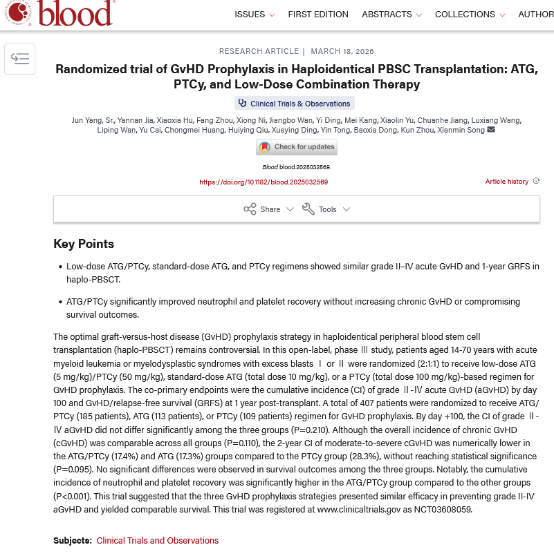
On March 18, research team led by Professor Song Xianmin from the Department of Hematology at Shanghai General Hospital (Shanghai Jiao Tong University School of Medicine) published an article online in the top hematology journal Blood, titled Randomized trial of GvHD Prophylaxis in haploidentical PBSCT Transplantation: ATG, PTCy, and Low-Dose Combination Therapy. This study is the first to systematically demonstrate that the three current GvHD prophylaxis strategies are generally “equivalent” in efficacy but exhibit mechanistic differences in immune reconstitution and early recovery. The findings indicate that the selection of GvHD prophylaxis strategies should no longer pursue a single “optimal approach,” but should instead be precisely and individually matched based on patient characteristics, infection risk, and transplantation goals.
Allogeneic hematopoietic stem cell transplantation (allo-HSCT) is a critical treatment for achieving long-term survival or even cure in hematologic malignancies. However, graft-versus-host disease (GvHD) remains a core bottleneck limiting transplant efficacy and affecting patient prognosis. Balancing effective GvHD prophylaxis with immune reconstitution and anti-tumor effects has long been a key clinical challenge in the field of transplantation.
Currently, the two most widely used GvHD prophylaxis strategies in clinical practice are anti-thymocyte globulin (ATG) and post-transplant cyclophosphamide (PTCy), representing two distinct approaches: “in vitro immune depletion” and “in vivo immune modulation.” Although both strategies have demonstrated certain advantages across different patient populations and transplantation modes, there remains room for improvement in enhancing GvHD prophylaxis efficacy in the high-risk setting of haploidentical peripheral blood stem cell transplantation (haplo-PBSCT).
Since 2017, the Department of Hematology at Shanghai General Hospital has pioneered a low-dose ATG/PTCy combination regimen. Building on promising preliminary clinical results, the department led a study: a prospective, multicenter, randomized phase III clinical trial (NCT03608059) designed to systematically evaluate the efficacy and safety of ATG, PTCy, and the low-dose ATG/PTCy combination regimen in haplo-PBSCT.
This study first internationally conducted a “head-to-head” comparison of the three GvHD prophylaxis strategies. A total of 407 patients with acute myeloid leukemia (AML) or high-risk myelodysplastic syndrome (MDS) were enrolled and randomly assigned to the three groups in a 2:1:1 ratio. The primary endpoints were the incidence of grade II–IV acute GvHD within 100 days post-transplantation and the 1-year GvHD-free, relapse-free survival (GRFS) rate.
The study results showed that, in terms of GvHD control, the three strategies achieved comparable overall efficacy. There was no significant difference in the incidence of grade II–IV acute GvHD at 100 days among the three groups. However, the ATG/PTCy regimen showed certain advantages in preventing overall acute GvHD, with a significant benefit observed in AML patients. The overall incidence of chronic GvHD was also similar among the groups, but the ATG/PTCy and ATG regimens were superior to PTCy alone in preventing moderate-to-severe chronic GvHD.
Regarding survival outcomes, no significant differences were observed among the three groups in 1-year GRFS, overall survival (OS), or disease-free survival (DFS), indicating comparable long-term efficacy across the three strategies. Notably, in terms of hematopoietic reconstitution, the low-dose ATG combined with PTCy regimen demonstrated significant advantages, markedly accelerating neutrophil and platelet recovery (P < 0.001), suggesting potential clinical value in early post-transplant recovery.
Furthermore, the study revealed significant differences in immune reconstitution pathways among the strategies. The PTCy regimen was more favorable for the recovery of regulatory T cells (Treg) and CD4+ T cells, and significantly reduced the risk of EBV reactivation. In contrast, ATG-based regimens offered advantages in NK cell reconstitution. These immunological differences suggest that different GvHD prophylaxis strategies not only impact clinical outcomes but also profoundly shape the post-transplant immune ecosystem.
This study provides high-quality evidence-based medicine for GvHD prophylaxis strategies in haplo-PBSCT, promoting a shift in clinical practice from experience-driven to mechanism-guided and individualized decision-making. Moving forward, the team will continue to conduct in-depth research on further optimizing combination strategies based on immune reconstitution characteristics and identifying the patient populations most likely to benefit.
This study was led by Shanghai General Hospital (Shanghai Jiao Tong University School of Medicine), in collaboration with multiple domestic institutions, including Ruijin Hospital Affiliated to Shanghai Jiao Tong University School of Medicine, the 960th Hospital of the Joint Logistics Support Force of the People’s Liberation Army (Jinan), Changhai Hospital Affiliated to Naval Medical University, Xinhua Hospital Affiliated to Shanghai Jiao Tong University School of Medicine, and Tongji Hospital Affiliated to Tongji University. The study was supported by the Second Round of the “Three-Year Action Plan (2020–2022) for Promoting Clinical Skills and Clinical Innovation in Municipal Hospitals” of the Shanghai Hospital Development Center and the Clinical Research Center of Shanghai General Hospital.
Source:https://mp.weixin.qq.com/s/sQQT59p3v17iSuqMClFbFg