
- News
New Research Progress in Precised Diagnosis and Treatment of Osteosarcoma
Recently, research on precision classification and individualized diagnosis and treatment of osteosarcoma conducted by Department of Orthopaedic Oncology Shanghai General Hospital in collaboration with the Shanghai Bone Tumor Institution leveraging the “Shanghai Bone Tumor Disease-Specific Database” has achieved important milestone progress in the precision classification and individualized diagnosis and treatment of osteosarcoma. The related research findings have recently been accepted for publication in leading international journals.
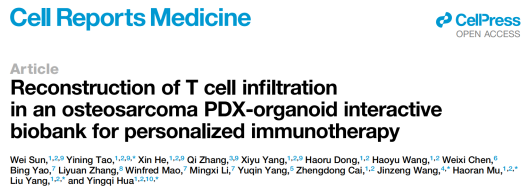
On February 27, 2026, Cell Reports Medicine, a Cell Press journal, published online a study jointly completed by the team in collaboration with Shanghai Apeiron Therapeutics Co., Ltd. By enabling self-assembly of single-cell suspensions, the researchers established individualized osteosarcoma organoid models (iOS) and built an interactive osteosarcoma “PDX–organoid” biobank. The iOS models faithfully recapitulate the spatial architecture and structural features of osteosarcoma at the millimeter scale in vitro and, when engrafted as xenografts, and form functionally paired counterparts with matched PDX models to support comparative studies. The fidelity of iOS was systematically validated through multidimensional profiling, including histopathology, spatial feature analysis, genomics, transcriptomics, and single-cell transcriptomics. By reconstituting T-cell infiltration in PDX-derived iOS models, the study enabled assessment of therapy-associated immune responses and provided a platform to facilitate translational immunotherapy research. Furthermore, in osteosarcoma organoid models harboring 9p21.3 deletion, the team demonstrated that the second-generation PRMT5MTA inhibitor ARPN2169 can enhance responses to immunotherapy. This target has emerged as a focal point in the field of synthetic lethal anticancer strategies, with active global efforts across major pharmaceutical companies. The osteosarcoma organoid biobank developed by the team offers a “trial-ready” preclinical model platform for evaluating such agents, thereby accelerating clinical translation.
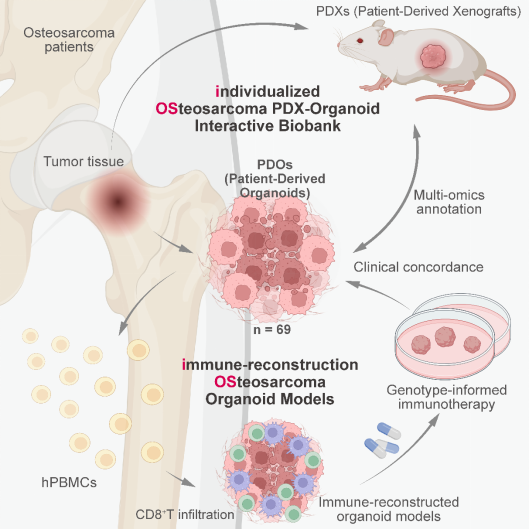
Graphical abstract (Cell Rep Med., 2026)
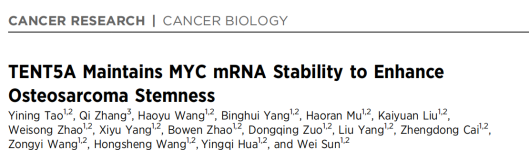
On January 30, 2026, Cancer Research, a journal of the American Association for Cancer Research (AACR), published online the team’s latest work building on its prior multi-omics–based molecular stratification of osteosarcoma (Nature Communications, 2022). By integrating multi-omics datasets from clinical cohorts-including genomics, transcriptomics, Tail Iso-seq, and single-cell profiling—this study systematically demonstrated that TENT5A, a cytoplasmic non-canonical poly(A) polymerase, is selectively upregulated in highly aggressive and metastatic osteosarcoma, particularly the MYC-driven subtype. Mechanistically, TENT5A directly binds MYC mRNA via its PAP/OAS1 domain and stabilizes the poly(A) tail, thereby sustaining aberrantly high MYC expression at the post-transcriptional level and ultimately promoting osteosarcoma stemness maintenance, chemoresistance, and metastasis. Importantly, the study elucidates the molecular basis underlying the clinically observed discordance between MYC copy-number alterations and transcriptional activity. Leveraging the osteosarcoma organoid biobank, the team further showed that inhibiting TENT5A function can restore chemosensitivity, offering a novel indirect therapeutic strategy to target the traditionally “undruggable” MYC protein. This work represents a continuation of the osteosarcoma “PDX-organoid interactive biobank” program-using osteosarcoma organoids as a translational bridge to enable a rapid pipeline from molecular stratification to mechanistic discovery and validation of actionable therapeutic targets.
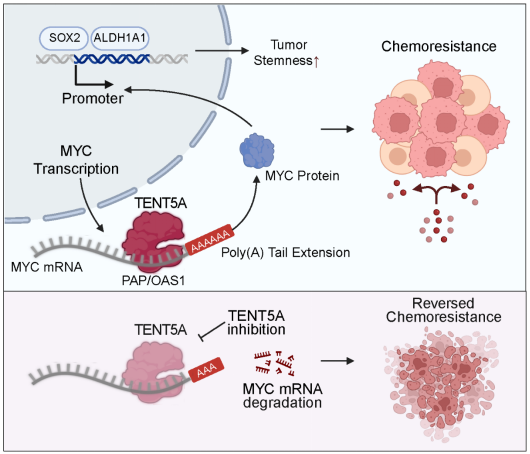
Graphical abstract (Cancer Res., 2026)
On March 3, 2026, Oncogene (Nature Portfolio) published a key advance in osteosarcoma targeted therapy–immunotherapy combinations. The study identified Ginkgetin (Gink) from a natural-product library as a novel inhibitor of the ER chaperone GRP78, confirmed by CETSA, SPR, and mutational analyses, with K296 defined as a critical binding site. Mechanistically, Gink disrupts the GRP78–PERK interaction to activate the PERK-eIF2α-ATF4 ER-stress program, suppressing proliferation, migration, and invasion while inducing apoptosis/autophagy. In orthotopic and PDX models, Gink significantly inhibited tumor growth and metastasis, and it reshaped the immune microenvironment by limiting M2-like macrophage polarization and synergizing with anti–PD-1 therapy to enhance CD8⁺ T-cell antitumor activity-supporting a dual-pathway, translational combination strategy for osteosarcoma.
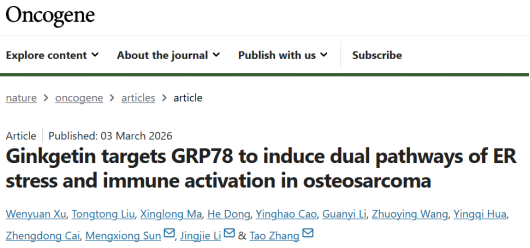
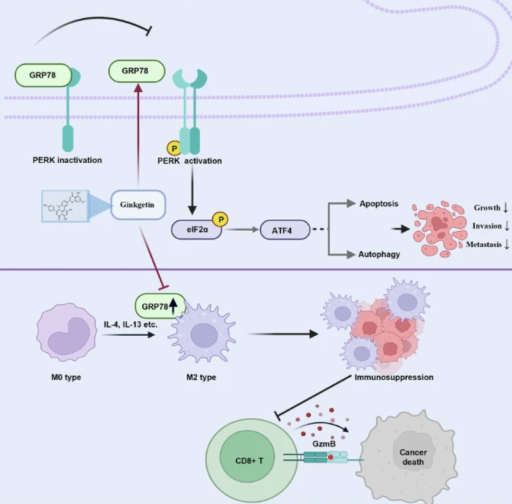
Graphical abstract (Oncegene., 2026)
Precision diagnosis and treatment is the key to overcoming the prognostic bottleneck in osteosarcoma
In 2022, the research team published the world’s first multi-omics–based molecular classification study of osteosarcoma in Nature Communications, identifying a highly aggressive, metastatic subtype with particularly poor outcomes (the MYC-driven subtype). These findings have since been independently replicated and widely recognized by the international community. Building on this work, the team further developed a clinically applicable NGS-based diagnostic method and assay kit (JCO Precision Oncology, 2025). Notably, a domestically developed, first-in-class MYC inhibitor targeting this high-risk subtype has now advanced to Phase II clinical trials (NPJ Precision Oncology, 2026).
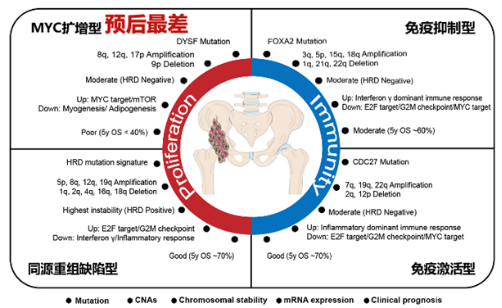
Discipline Overview
Founded by Professor Zhengdong Cai, the Department of Orthopaedic Oncology, Shanghai General Hospital, together with the Shanghai Bone Tumor Institution, is one of China’s leading centers for the integrated care and research of bone and soft-tissue tumors. As a flagship discipline of the hospital, the department focuses on surgical resection and reconstruction innovations, pediatric limb-salvage technologies, precision-therapy system development, and clinical studies of multidisciplinary treatment strategies.
Based at the Clinical Translational Research Institute (Songjiang Campus), the Shanghai Bone Tumor Institution provides a full-spectrum platform spanning basic, translational, and clinical research. It has established in-house organoid/PDX model pipelines and biobanks, and leads the development of the Shanghai Bone Tumor Disease-Specific Database.
Clinical Strengths
Surgical resection and reconstruction for malignant bone tumors involving the extremities, pelvis/sacrum, and spine; limb-salvage treatment for pediatric malignant bone tumors; comprehensive and minimally invasive management of skeletal metastases; and multidisciplinary systemic therapy—including chemotherapy and immunotherapy—supported by investigator-initiated and industry-sponsored clinical trials in bone and soft-tissue tumors. Case volume and clinical outcomes are at an internationally advanced level. Equipped with state-of-the-art facilities, the department delivers patient-centered care guided by modern multidisciplinary surgical oncology principles and compassionate humanistic support for patients with bone tumors and related musculoskeletal diseases.
Talent Cultivation
The team has been recognized by various national, provincial, and ministerial talent programs, including the National Excellent Young Physician Program under the National Health Commission's High-level Talent Program, Shanghai Leading Talent Program, Shanghai Top Young Talent Program, Shanghai Silver Snake Award, Shanghai Oriental Excellent Talent Program, Shanghai Science and Technology “Morning Star” Talent Program, and Shanghai Pujiang Talent Program. The team's achievements in improving the efficacy of resection and reconstruction for pelvic ring tumors have been recognized with the first prize of the Science and Technology Award of the Chinese Medical Association and the second prize of the Shanghai Science and Technology Progress Award. Additionally, the team's accomplishments in standardized surgery and precision treatment for osteosarcoma have earned the first prize of the Ministry of Education's Science and Technology Progress Award and the second prize of the Shanghai Science and Technology Progress Award.
Translational Research
The team’s translational studies have been published in leading international journals, including Nat Commun., Cell Rep Med, Cancer Res, J Immunother Cancer., Signal Transduct Target Ther., Proc Natl Acad Sci U S A., Adv Sci (Weinh)., Aggregate, Oncogene, Biomaterials. Over the past five years, the team has secured more than 30 competitive grants, including awards from the National Key R&D Program of China, the National Natural Science Foundation of China, and other provincial/ministerial funding programs. Focusing on innovative targeted therapeutics for bone tumors, molecular subtyping diagnostic kits for osteosarcoma, circulating tumor cell (CTC)–based liquid biopsy assays, pediatric limb-salvage prosthesis systems, and organic–inorganic composite bioresorbable bone substitutes, the team has obtained multiple Chinese patents and achieved successful translation. The cumulative technology-transfer value has exceeded RMB 5 million, and several products have received marketing authorization/registration approval.
Clinical Research
The department has continuously strengthened its clinical research infrastructure for bone and soft-tissue tumors, with related work published in leading international journals such as J Immunother Cancer., J Bone Joint Surg Am., Bone Joint J., NPJ Precis Oncol. The team currently leads or serves as a key participating center in multiple international and domestic clinical studies, and has launched a series of innovative investigator-initiated trials in bone and soft-tissue tumors, including China’s first umbrella precision-therapy trial for osteosarcoma; the first study of B7-H3 CAR-T therapy in advanced bone and soft-tissue tumors; a clinical study of tumor-infiltrating lymphocyte (TIL) therapy in osteosarcoma; a clinical study of Epenemine in chondrosarcoma; and trials exploring oncolytic virus–based combinations with TCR-T therapy for bone and soft-tissue tumors. These advances have been presented at major national and international conferences, including ASCO, AACR, CTOS, CSCO, and COA.
Source: https://mp.weixin.qq.com/s/LuLR6qfTx-GmyHlBX2Y-zA