
- News
Premature Twins Sisters Suffer from Eye Diseases, and Shanghai General Hospital Multidisciplinary Joint Precision Surgery Ensures Brightness
Only after 31 weeks+6 days of gestation in the mother's body, the birth weight was only 1.75 kg - Yangyang and An An (pseudonym), the premature twin sisters, had just managed to survive the most dangerous two months after birth, they encountered another crisis: both sisters were diagnosed with retinopathy of prematurity (ROP), and if not treated in time, they might lead to permanent vision damage or even blindness. Recently, the Ophthalmology Center of Shanghai General Hospital, in collaboration with multidisciplinary teams such as the Department of Anesthesiology and neonatology, successfully completed the treatment of twins suffering from retinopathy of prematurity, preserving possibility of seeing the world clearly for them.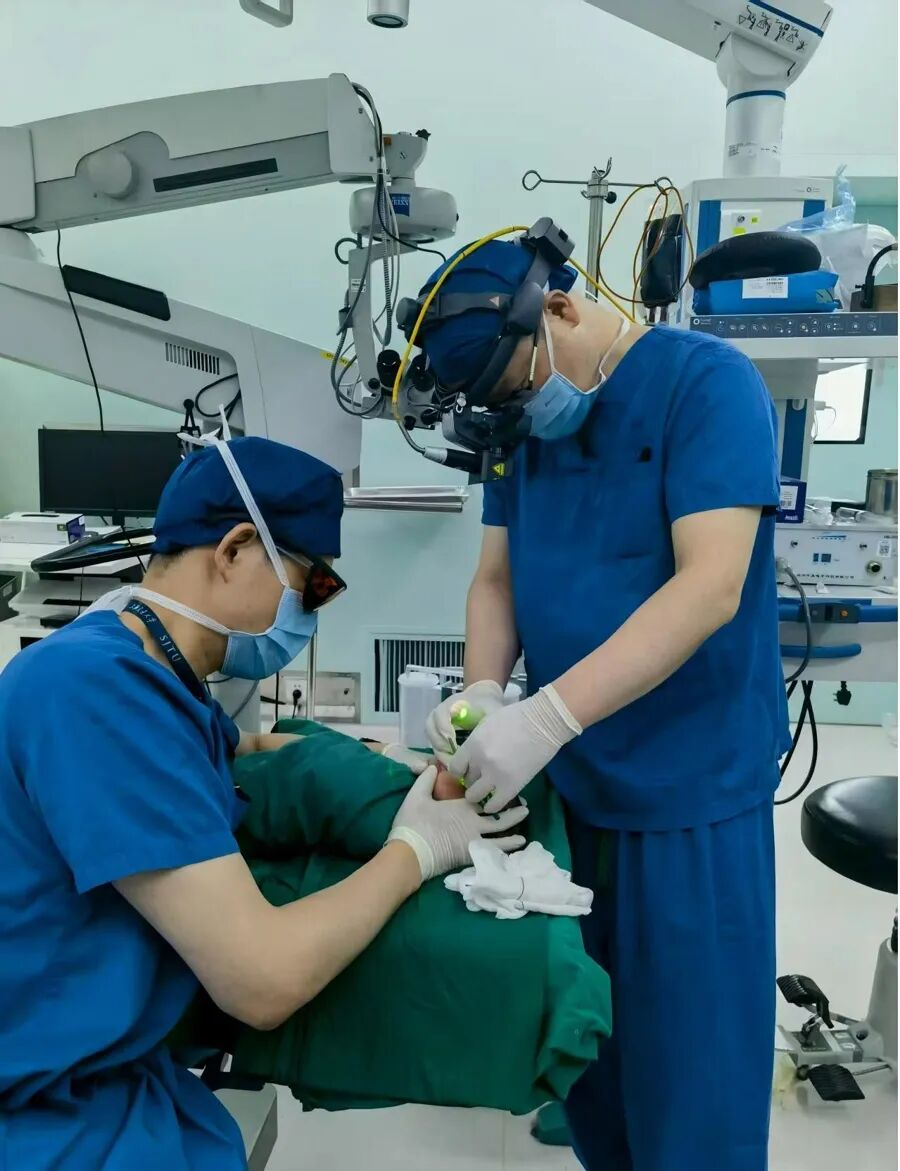
Yang Yang and An An were both diagnosed with retinopathy of prematurity (ROP) during a wide-angle fundus examination 2 months after birth. Among them, Anan has stage 3 lesions (PLUS+), which can be controlled through laser photocoagulation; Yang Yang has developed to stage 4 lesions (PLUS+) and must undergo vitrectomy (LSV) with preserved lens to save vision.
The visual threat of ROP to premature infants is devastating, especially after reaching stage 4, with each day of delay increasing the risk of vision loss by one percent. However, Yangyang was born only 2 months ago and has a fragile body. The difficulty of surgery and anesthesia far exceeds that of adults and older children.
Ji Xunda, Director of Eye Tumor and Pediatric Fundus Department, immediately led the launch of the green channel for the treatment of retinopathy of prematurity. The multidisciplinary teams including Pediatric Fundus Department, Neonatology Department, Anesthesia Department, Operating Room and Nursing Department cooperated closely. On the same day, retinal laser photocoagulation and intravitreal injection were performed for the twin sisters.
The next challenge is to perform vitrectomy (LSV) for Yang Yang. In order to ensure surgical safety, teams from pediatric ophthalmology, neonatology, anesthesiology, operating room, nursing department, etc. work closely together: neonatology comprehensively evaluates basic indicators such as twin heart and lung function and weight gain to provide a foundation for surgical tolerance; The anesthesia team has developed a personalized general anesthesia plan for premature infants with weak cardiopulmonary function and light weight. From precise conversion of anesthesia drug dosage to real-time dynamic monitoring of intraoperative heart rate, blood oxygen, and blood pressure, every step is carefully considered to ensure the safety and stability of the anesthesia process. In the end, Chief Anesthesiologist Qiu Yimin and Associate Chief Anesthesiologist Zhu Jiali successfully performed general anesthesia induction and tracheal intubation for Yang Yang.
The real test is on the operating table. The structure of children's eyes is only one-third of that of adults, and vitrectomy (LSV) with preserved lenses requires precise removal of diseased tissue in a very small operating space, with almost zero fault tolerance. Ji Xunda led the pediatric fundus disease team to successfully complete the surgery for Yang Yang with rich clinical experience and exquisite skills, under the escort of the anesthesia department. After surgery, the patient was smoothly transferred to PACU for further observation. The neonatology and anesthesia teams seamlessly integrate monitoring and closely monitor the vital signs of the children. As of the time of writing, Yang Yang has successfully passed the critical period and been discharged safely.
The Ophthalmic Center of Shanghai First People's Hospital specializes in ophthalmic tumors and pediatric fundus diseases, relying on the National Clinical Medical Research Center for Ophthalmic Diseases. It has established departments including anesthesiology, cerebrovascular intervention, pediatrics, and neonatology ICU. A multidisciplinary diagnosis and treatment team, including radiology and pathology departments, has established a comprehensive one-stop diagnosis and treatment system for pediatric fundus diseases, providing professional ophthalmic diagnosis and treatment services for every child facing visual challenges.
source:https://mp.weixin.qq.com/s/2OXHXgOXsewFIrcNfEbHtQ?scene=1&click_id=3